
Do Car Washes Damage Paint? 5 Telltale Signs of Swirl Marks and Scratches
If you're here because your once-glossy car paint now looks hazy or scratched, this guide will help you diagnose the damage, understand the cause, and learn how to safely restore and protect your investment.

It’s a frustrating moment every car owner dreads. You’ve invested in a beautiful vehicle, maybe a BMW with that deep, metallic black paint. One day, you catch it in the sun just right and you see it: a fine web of marks on the car's paint that has stolen its showroom shine.

Believe me, I’ve seen that look of disappointment on hundreds of owners' faces with all types of cars. I’m Daniel Do, founder of Meticulous Car Detailing. For years, my team has specialised in professional car detailing and correcting the very type of vehicle damage that often starts with a simple, convenient wash. My goal here is not to sell you, but to empower you with the professional knowledge to spot, prevent, and fix surface issues, so you can protect your automotive paint investment.
Here’s your roadmap from concern to confidence in your car care routine:
- Understanding Your Vehicle's Fragile Finish
- The Main Causes of Damage from a Car Wash
- How to Spot 5 Telltale Signs of an Issue
- The True Cost of a "Cheap" Wash
- A Safe Method for a Scratch-Free Wash
- The Ultimate Defence: Long-Term Protection
- Your Next Step to a Showroom Shine
Understanding Your Car's Fragile Finish
Before we can diagnose the problem of swirl marks and other imperfections, you need to understand the surface we're trying to protect. The glossy finish on your car isn’t the paint itself; it’s a transparent top layer called the clear coat. It’s what gives a Black Sapphire Metallic BMW its liquid depth or a crisp Alpine White Mercedes its brilliant shine.
Here’s the single most important insight I can share: this protective clear coat is only about 50 microns thick, roughly the thickness of a single human hair.
This is why your vehicle's finish is so fragile. That microscopic shield is the only thing protecting your car’s colour from the elements. When it gets scratched, even lightly, it fractures the light instead of reflecting it, creating the hazy, swirled look that kills your car's gloss. Improper washing is, without a doubt, the number one cause of this clear coat issue.
The Two Main Causes from a Car Wash
So, where do fine scratches and imperfections come from? Every form of surface issue from an automatic car wash boils down to two simple enemies: uncontrolled friction and harsh chemicals.
Any method that drags grit across your finish will act like sandpaper. Any method that uses aggressive, caustic soap is like using oven cleaner on a fine piece of furniture. Both lead to costly issues, so that your only real defence is to choose a safe car washing method that controls these two factors.
Tunnel Washes (Brushes and "Soft" Cloths)
This is the fastest way a new car loses its shine. The giant spinning brushes or cloths in these automatic wash tunnels collect abrasive grit and dirt from every single vehicle that goes before you. The mechanism of damage is simple: those brushes grind that trapped debris directly into your paint, inflicting thousands of microscratches and swirl marks in a single pass.
Touchless Car Washes
A touchless wash avoids mechanical abrasion, which seems like the perfect solution. But this introduces the second enemy: harsh chemicals. To strip away grime without any physical contact, these systems often rely on powerful detergents with a high pH. These aggressive soaps can strip away your car's wax, sealant, or other protection, leaving the clear coat naked and exposed to UV rays and contaminants.
How to Spot 5 Telltale Signs of an Issue
Now that you know the causes, you can learn to spot the effects of wash issues like a professional. You don't need special equipment; you just need the right light and the right technique to identify common paint problems.
How to Inspect a Car for any Scratch or Swirl Marks
First, find the right light. Direct sunlight is the most honest light source available for spotting imperfections. If it's overcast, use a single, bright light source like your phone's torch in a dark garage to inspect the finish.
Next, don’t look at the surface itself. Focus on the reflection of the light source on a panel, like the reflection of the sun on your bonnet. This is where the damage will appear as a distorted halo or web around that bright spot. Now, let’s look at what you’re searching for.
1. Fine Circular Patterns
This is the classic sign of improper wash technique. It's that fine, circular spiderweb pattern you see around a light source. These are thousands of microscopic scratches that kill the deep, liquid look of your paint, making it appear dull and hazy over time.
2. Deeper Lines and Marks
Deeper than swirls, these are isolated marks on the vehicle paint you can often feel with your fingernail. They are usually caused by a larger piece of debris caught in a wash brush or dirty wash mitt.
3. Dullness or Fading
If your car’s vibrant colour now looks flat and lifeless, you’re likely seeing the cumulative effect of dense microscratches. This network of scratches diffuses light instead of reflecting it, robbing the finish of its natural shine and gloss.
4. Water Spots
Those white, chalky spots are mineral deposits left behind when water evaporates on the surface. Automated car washes with poor drying systems are a common cause. If not removed quickly, these minerals can be corrosive and permanently etch into the clear coat.
5. Chemical Staining
Sometimes, the aggressive soaps in touchless washes can leave a faint film that resembles a rainbow on the paint or cause sensitive plastic and rubber trims to look faded and brittle. This is a clear sign the chemicals are too harsh for your vehicle's finish.
The True Cost of a "Cheap" Wash
At this point, you might be asking: "Do a few fine marks really matter that much?" From a financial perspective, absolutely.
Saving $15 on a convenient automatic system today could easily cost you $1,500 or more in lost resale value on a prestige vehicle. Poor surface condition is one of the first things a buyer or dealer will notice, and they will use it to aggressively negotiate down your price. Professional paint correction to remove this damage typically costs between $800 and $2,500, a direct cost you will either pay yourself or lose on the sale.
The Professional's Method for a Scratch-Free Car Wash
The good news is that preventing this issue is entirely within your control. The car detailing industry's gold standard is the two-bucket method, a simple framework built on one powerful philosophy: isolate the enemy. This is the safest way for a hand wash without marking the finish.
The enemy is grit. The moment your wash mitt picks up a single piece of grit, it becomes sandpaper. The second "rinse" bucket's only job is to be a cleaning station for your mitt. After washing a panel, you dunk the dirty mitt in the rinse bucket first, releasing the trapped grit. Only then do you return the clean mitt to the soap bucket. This simple separation is the entire secret to a scratch-free wash.
How to Perform Two-Bucket Washing Safely
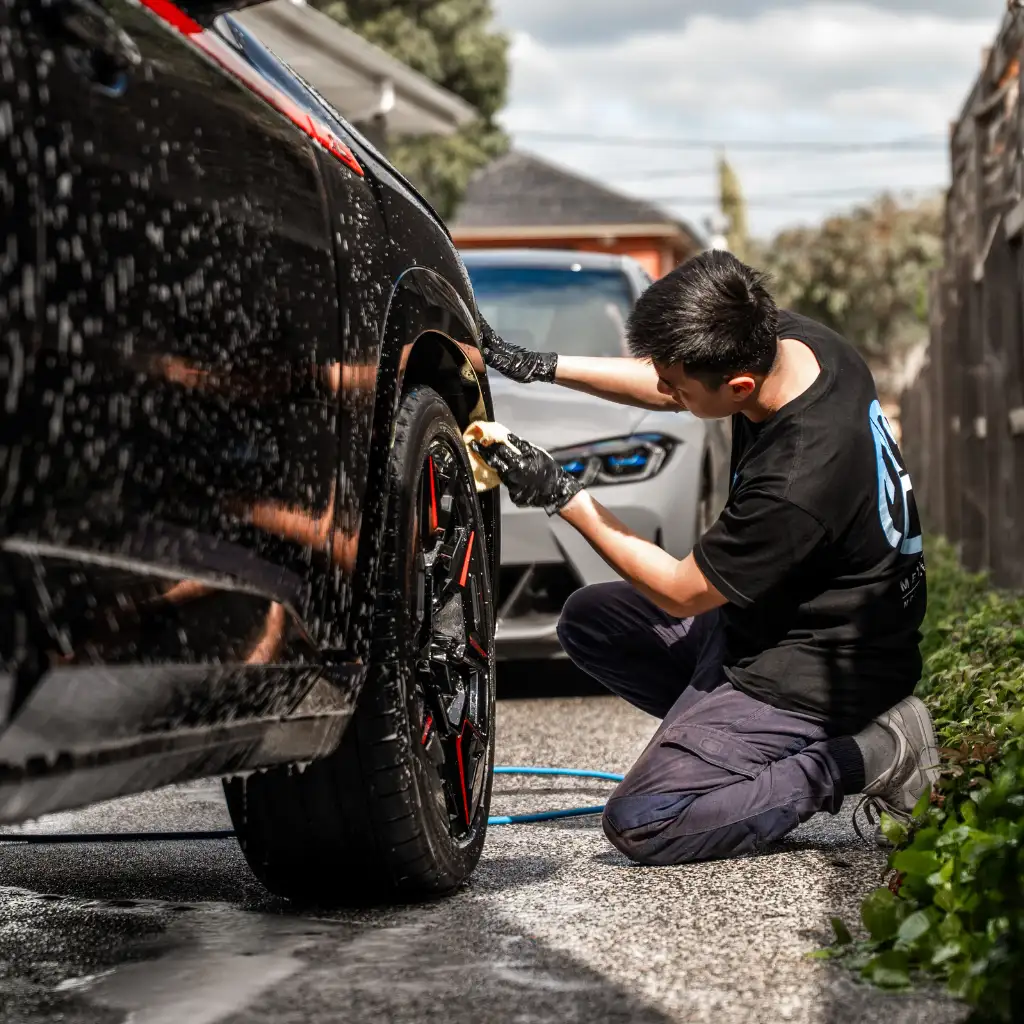
- Step 1: Gather Your Tools. You’ll need two buckets (ideally with grit guards at the bottom), a quality pH neutral car shampoo, and a plush microfiber wash mitt (not a sponge).
- Step 2: Pre-Rinse Thoroughly. Always work in the shade. Use a hose or pressure washer to rinse the car from top to bottom, removing as much loose dirt and dust as possible before you ever touch the surface.
- Step 3: The Two-Bucket Process.
- Fill one bucket with your shampoo solution (the "Wash" bucket) and the second with plain water (the "Rinse" bucket).
- Dunk your mitt in the "Wash" bucket and clean a single panel, starting from the roof and working your way down.
- CRITICAL STEP: Before getting more soap, plunge the dirty mitt into the "Rinse" bucket and swish it against the grit guard. This traps the dirt, ensuring your mitt is clean.
- Now, you can safely return to the "Wash" bucket for fresh, clean soap and move to the next panel.
- Step 4: Dry Safely with a Microfiber Towel. Never let the car air dry in the sun. Gently pat or drag a large, clean microfiber drying towel across the surface to absorb the water without scratching.
The Ultimate Defence: Long-Term Protection
A proper wash is the foundation of good car care, but for a high-value asset, a durable, sacrificial barrier is the best form of insurance. This is where professional restoration services like surface correction and ceramic coatings come in.
Step 1: Fixing Damage with Paint Correction
If your car already has fine scratches, no amount of cleaning will remove them. The only true solution is a process called paint correction.
The philosophy here is one of precision. We are not just "buffing" the car; we are using specialised machines and polishes to carefully remove a microscopic layer of the affected clear coat, often just 1-3 microns thick. This is the only way to create a perfectly flat, optically pure surface that reflects light perfectly, restoring the deep, flawless finish your car had the day you drove it home.
Step 2: Apply Long-Term Protection with a Ceramic Coating
After the surface has been restored to a perfect finish, you must protect it. A ceramic coating is a liquid polymer that forms a chemical bond with your car's clear coat, creating a sacrificial layer that is significantly harder and more durable than the factory finish itself.
For a vehicle owner, this means superior vehicle protection against UV rays, bird droppings, and light scratches. It also makes the car incredibly easy to clean, so that you can maintain that perfect finish with far less effort.
Your Next Step to Reclaim a Showroom Shine
Seeing imperfections in your car's finish is disheartening, but you are now in a position of control. You understand the risks, know how to spot surface issues, and have a proven method for safe cleaning. You have two clear paths forward.
The DIY Preservation Path
If your car has minimal issues and you enjoy car detailing, committing to the two-bucket method is a fantastic way to preserve your finish and prevent future imperfections. This is a rewarding path for any hands-on owner.
The Professional Restoration Path
If your vehicle already has visible imperfections, or if you simply want the best possible finish and protection without spending your weekends cleaning your car, the professional path is the most effective solution. As a first step, we offer a completely free, no obligation Paint Inspection at our Springvale workshop. We’ll put your car under specialised lights, show you exactly what’s happening, and give you a clear, transparent surface restoration plan. It’s an educational process, not a sales pitch, designed to give you all the information you need.
Frequently Asked Questions
What are these circular patterns?
These fine lines are thousands of microscopic scratches on the surface of your car's clear coat. They are not in the paint itself, but on the protective top layer. Caused by improper cleaning techniques, like using dirty sponges or automatic car washes, these scratches refract light in multiple directions, creating a "spiderweb" or hazy effect that is most visible in direct sunlight.
Can these marks be removed permanently?
Yes, these marks can be permanently removed through a professional service called surface correction. Unlike waxes or polishes that merely fill in scratches temporarily, this process uses machine polishers and abrasive compounds to carefully level the clear coat, permanently eliminating the scratches and restoring the surface's reflective, glossy finish.
Paint Correction vs. Car Polish
The primary difference is the level of restoration. A car polish is a light duty, often single step process that uses fine abrasives to enhance gloss and remove very minor imperfections. Paint correction, in contrast, is an intensive, multi stage process that uses a range of abrasive compounds to remove a microscopic layer of the clear coat, targeting more significant defects like fine lines, scratches, and water spots for a complete surface restoration.
Is a ceramic coating worth the cost?
For owners seeking maximum long-term protection, a ceramic coating is a highly valuable investment after correction. The main tradeoff is the higher upfront cost compared to a traditional wax. However, the benefits include superior durability (years of protection vs. months), enhanced resistance to chemicals and UV rays, and hydrophobic properties that make the vehicle significantly easier to clean, preserving the flawless finish achieved by the correction process.
How can a touchless system cause issues?
Touchless car washes cause problems by using harsh, high pH chemical detergents to break down dirt and grime. These aggressive chemicals are strong enough to strip away your car's protective layers, such as wax or sealant. This leaves the underlying clear coat exposed and vulnerable to damage from UV radiation, acid rain, bird droppings, and other environmental contaminants, leading to fading and premature ageing.